GST billing and accounts
The invoice and the ledger agree, by construction.
Exporting sales into a separate accounting tool every month creates rework and differences nobody can fully explain. Posting the invoice straight into the ledger it's reported from removes the gap.
Sound familiar?
Why this is a real gap, not a feature request.
Month-end is a reconciliation exercise
Sales figures from the CRM and the numbers in the accounting tool rarely match exactly, and finding why eats a day every month.
The accountant is handed a spreadsheet, not a system
GST workings get rebuilt by hand from exported data instead of being read straight from the books.
Once this is solved
What is true that wasn't before.
GST worked out from the place of supply
CGST/SGST versus IGST derived from the two state codes on the document, not chosen by whoever is typing.
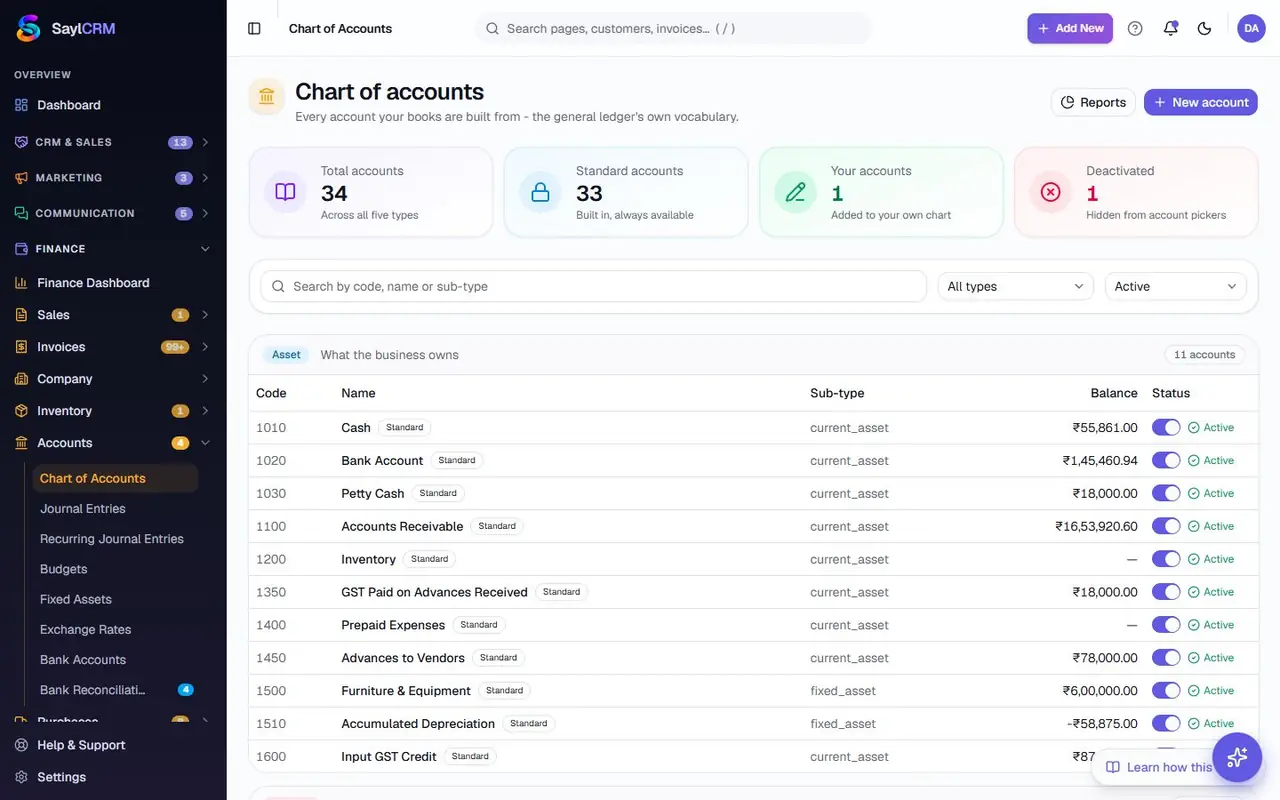
A double-entry ledger behind every report
Trial balance, P&L and balance sheet are queries over the same journal the invoices posted — not a parallel calculation.
Bank statements matched, not retyped
An imported statement is matched to an invoice, matched to a bill, or categorised — never left unresolved.
GST workpapers your accountant can actually use
GSTR-1, GSTR-3B and GSTR-2B reconciliation prepared from the books, ready to hand over.
How it's built
No single product does this alone.
This is what happens when the products below work on the same record, not a thirteenth piece of software.
In practice
What this looks like on a real Tuesday.
An accountant preparing the monthly GSTR-3B
The workpaper is built from invoices and bills already posted to the ledger, not re-assembled from an export someone emailed on the 9th.
A business reconciling last month's bank statement
An imported statement line matches an outstanding invoice automatically; what's left over is categorised or flagged, so nothing sits unexplained in the books.
Ready when you are
See "GST billing and accounts" running on your own workflow.
Bring the specific version of this problem you actually have — we will walk it through on the real product, not a slide.